How bamboo bioenergy can help power remote communities
Bioenergy has increased in popularity as a desirable form of energy over the past decade. Europe has been the leader in this innovation, driven predominantly through the use of wood waste from the United States.

1422965065-3 (650x488)
However, sustainability and the high carbon footprint associated with the transportation of the material often long distances between source and energy plants, and the industry in general have been controversial.

Yet there are instances in which bioenergy can be a truly sustainable source of power, in a context where alternatives are simply not feasible.

The island nation of Indonesia is one of the fastest growing countries in the world. Their deforestation footprint is significant, grouping them together with China and the United States as one of the world’s top emitters of greenhouse gases.

With more than 17,000 islands and a rapidly growing economy, energy security for the more developed islands, and electrification of the less developed islands has become a priority for the government under new President Widodo.

Under Widodo’s proposed energy reform, a government mandate of moving the country towards renewable forms of power, and in the context of an island nation, there are three main requirements which determine the suitability of any particular form of renewable energy: it must be distributed; it must be local; and it must be available on demand. Bioenergy meets all these requirements.

Indonesian entity Clean Power Indonesia (CPI) has signed an exclusive agreement to bring General Electric’s biogasification technology to the island of Bali. With an ever growing tourism industry, the island’s need for energy is on the rise.

But for bioenergy to be both renewable and environmentally positive, a secure and stable feedstock is required, and this feedstock must be produced to the benefit, rather than the detriment of the environment. The solution? Commercially grown and sustainably harvested bamboo.

US based EcoPlanet Bamboo Group has co-invested with CPI in the development of GE’s plant, and committed to convert degraded land in proximity to the bioenergy facilities into a permanent source of feedstock. Non invasive tropical clumping bamboo reaches maturity within seven years, and thereafter a portion of each plant can be harvested annually, providing a continuous supply of biomass without the need to replant, and maintaining a continuous canopy cover and ecosystem.

Grown on degraded land, and with minimal transportation requirements, this closed loop production system will provide a carbon neutral form of power to an island well known for its positive attitude towards green living.

And the added benefit? The restoration of degraded land into bamboo forests has been shown to regenerate water tables, securing more regular rainfall patterns and increasing the occurrence of streams, rivers and other water bodies.

EcoPlanet Bamboo Group has already proven the concept of sustainability with regards to the commercial production of bamboo feedstock. The company’s plantations in Central America are triple certified with Forest Stewardship Council for their sustainable management, Verified Carbon Standard for their climate change benefits, and gold level Climate, Community and Biodiversity Standards for their quantified positive impact on both the environment and surrounding populations.

If the model is successful, its potential to be replicated across the Indonesian archipelago and provide an alternative to the use of diesel generators is immense.

Source: http://www.clickgreen.com/

Renewable Power Generation Costs in 2014
The competitiveness of renewable power generation technologies continued improving in 2013 and 2014, reaching historic levels. Biomass for power, hydropower, geothermal and onshore wind can all provide electricity competitively against fossil fuel-fired power generation. Solar photovoltaic (PV) power has also become increasingly competitive, with its levelised cost of electricity (LCOE) at utility scale falling by half in four years.

cost2015

Click here to download.

Renewable Power Generation Costs in 2014 aims to reduced uncertainty about the true costs of renewable power generation technologies, so that governments can be more ambitious and efficient in their policy support for renewables. As this comprehensive report from the International Renewable Energy Agency (IRENA) underlines, perceptions that such technologies are expensive or uncompetitive are outdated, at best.

Full report

Executive Summary

The report follows from IRENA’s first major costing study, Renewable Power Generation Costs in 2012.

For more of IRENA’s ongoing renewable energy cost analysis, see www.irena.org/costs.

Source: irena.org

Energy-saving buildings offer banks new financial products

Nearly half of the world’s energy consumption is a result of cooling, heating and ventilating buildings, while construction work is responsible for more than half of the globe’s resources consumption. Addressing these significant levels of consumption is becoming increasingly urgent with greenhouse gas emissions expected to double by 2030, with emerging markets among key contributors to this increase.


The World Bank’s IFC is providing $2 billion for sustainable energy project globally

To underline the dramatic increases in power consumption among developing countries, Vietnam posted a four-fold increase in just a decade to 2008 according to World Bank data and now faces significant power shortage issues. Construction is among the most energy-intensive industries, accounting for 36 per cent of the nation’s total annual energy consumption. Therefore, the sector’s improved energy efficiency is vital to helping energy saving in Vietnam. International Finance Corporation (IFC), a member of the World Bank Group, is helping the country tap this huge potential by developing energy efficient, green buildings. To achieve this, it is supporting the Ministry of Construction to enhance the implementation of the Energy Efficiency Code for Buildings, which has been revised to become more technically and economically feasible to implement. The Code is expected to save 15 per cent of energy consumption on every floor square metre.

“Financing energy efficiency and green buildings is not only vital for a sustainable future, but also a smart business approach,” said IFC’s Asia head of Climate Finance William Trant Beloe.

“This is a sustainable development trend and banks that develop this financial product will have an opportunity to access a new market with less risk, while promoting themselves as banks with high levels of social responsibility with green financing programs,” he told a “Energy Efficient Buildings and Green Buildings Financing” workshop, co-organised by IFC and the Vietnam Banking Association in Hanoi, on December 9, 2014.

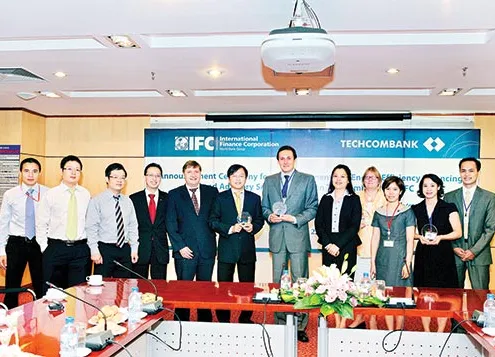
IFC’s Sustainable Energy Financing (SEF) programme has provided $2 billion in funding for sustainable energy projects globally through financial institutions In Vietnam, Techcombank and Vietinbank have committed $63 million for energy efficiency projects. These projects together have saved 259,512 megawatt hours and avoided GHG emissions by 130,377 tonnes of CO2 annually. It is expected to have other banks to join the programme.

IFC has also developed the EDGE Resources Efficiency Building Certification system, a tool to enable developers to save energy, water and resources in construction materials production, thus reducing GHG emissions. This tool is designed for emerging markets to develop different technical solutions for higher energy efficiency with respective estimated investment costs and savings for developers to choose the appropriate “green” levels for their projects.

Trant Beloe said IFC provides long-term credit lines to local banks that banks use to lend green building developers. IFC supports the design of appropriate financial products for each of its partner banks and technical assistance to partner banks to develop sustainable energy financing products encompassing energy efficiency, cleaner production in industries and energy efficient green buildings. This advisory programme includes capacity building for banks in sustainable energy financing and supports partner banks to participate in developing a sustainable energy finance market in Vietnam including green building finance. With EDGE, bank staff can also perform loan valuations for green homes more efficiently and have a better definition of green buildings as an “asset class”.

IFC is also active in training bank staff in energy efficient or green building financing as well as heightening developers and home buyer awareness of green financing options, providing an e-tool for green buildings and organizing workshops and forums to highlight energy efficiency opportunities to consolidate and fully tap the green building market’s rich potential in Vietnam.

Source vir.com.vn

Vietnam needs $30 billion for green growth strategy to 2020

Vietnam needs up to $30 billion to carry out its Green Growth Strategy from now to 2020, of which 70% will not come from the State budget.

Green Growth

The money will be used to perform 12 tasks focusing on 66 major activities related to institutions, zone planning, technology transfer, and business opportunities for business development and finance.

Vietnam will have to spend 2-6% of its GDP to readdress damages caused by climate change, according to Pham Hoang Mai from the Ministry of Planning and Investment’s.

Mai said Vietnam currently lacks policies to mobilize financial resources, especially from the International Climate Funds, while facing difficulties in attracting foreign and domestic investments.

The newly-promulgated National Green Growth Strategy and the National Action Plan on Green Growth for the period 2014-2020 are considered policies of utmost importance to the promotion of sustainable development in Vietnam, notably sustainable economic development as well as climate change adaptation, Mai noted.

Deputy Minister of Planning and Investment Nguyen The Phuong attributed these results to the close and effective cooperation between the Vietnamese and Korean governments through the support of the Korea International Cooperation Agency (KOICA) KOICA for the MoIT in realizing these projects.

Dr. Taeho Ro, Director General of Global Strategy Centre, of the Korea Environment Institute, said Vietnam is trying to apply green-growth strategies and experience and knowledge from a number of countries to deal with social changes and environmental diversity as a result of rapid industrialization and economic development.

He suggested that groups increase support for Vietnam in developing legal and institutional foundations in order to help protect the environment and stimulate socio-economic development.

Vietnam to receive ODA of US$3.9 million for green growth

The US Agency for International Development (USAID) in collaboration with the United Nations Development Program (UNDP) and the European Union (EU) has agreed to provide US$3.9 million of ODA for sustainable green growth projects.

The balance of the funding for the US$4.128 million projects to be implemented in Hanoi and surrounding provinces will be sourced from the Ministry of Planning and Investment (MPI) counterpart funds.

The projects are aimed at enhancing technical capacity for the MPI, the Ministry of Finance, the Ministry of Transport and other provinces to integrate the contents of green growth into the local budget and spending plans.

They are also expected to raise businesses and policy makers’ awareness about green growth and sustainable development, analysis on financial and investment policies, barriers, and support of policy dialogues.

The Prime Minister has asked the MPI to work with relevant agencies and the UNDP office in Vietnam to devise an annual plan to implement the projects in compliance with existing regulations and insure the ODA is used effectively.

VOV/VNN

Germany grants loan worth 200 mln euros for Vietnam’s energy sector

Germany has offered a loan worth 200 million euros for Vietnam’s energy sector during a recent visit by Dr. Friedrich Kitschelt, State Secretary in the Federal Ministry for Economic Cooperation and Development of Germany, to Vietnam.

2

Dr. Friedrich Kitschelt, State Secretary in the Federal Ministry for Economic Cooperation and Development of Germany, poses for a group picture in his visit to Lilama 2 vocational school in the southern province of Dong Nai during his visit to Vietnam from November 28- December 3, 2014. (Photo courtesy of the The German Embassy in Hanoi).

Dr. Kitschelt’s working trip, which lasted from November 28 to December 3, focused on the three following areas: vocational training, energy and environment.

During the visit, the Federal Ministry of Economic Cooperation and Development of Germany granted the preferential loan package aimed at modernizing the network transmission and distribution of electricity in medium and small cities in Vietnam.

“Efficient energy use is the focus area in green growth strategy of Vietnam. We believe that improved power grids applying new technologies will reduce energy consumption and reduce CO2 emissions during transmission, while ensuring the supply of electricity at low cost,” said Dr. Kitschelt.

“Thereby, Germany has contributed significantly to securing supplies as well as regional economic development and environmental protection for Vietnam,” he added.

During the six-day visit, State Secretary Kitschelt also witnessed the signing of a loan agreement worth 100 million euros with the Ministry of Finance of Vietnam for the improvement of the power grids in the capital city of Hanoi.

In addition, State Secretary Kitschelt also joined high-level talks with the Minister of Planning and Investment and the Vice Minister of Finance about policies to promote the private sector, as well as the framework conditions for economic development in Vietnam in the future in accordance with the National Strategy for Green Growth.

State Secretary Kitschelt also visited a Germany – Vietnam vocational training project and lauded the close cooperation between vocational training centers and German Bosch Group.

“During the vocational training, young students participating in the enterprise will accumulate experiences and best practices. As a result not only the participants, but also the businesses that invest in the training process will benefit from the training process, because after graduation they can start work right away,” said the German State Secretary.

During the high-level talks, the German State Secretary also proposed that the government of Vietnam create conditions for local enterprises to adapt this training model.

Source: tuoitrenews.vn

Green Growth on the Agenda for Vietnam PM’s Brussels Visit

Prime Minister Nguyen Tan Dung shakes hands with Belgian officials after arriving at Brussels Military Airport on October 12. 2014. Photo credit: Vietnam News Agency

Prime Minister Nguyen Tan Dung arrived in Belgium for the first leg of his week-long Europe visit on Sunday afternoon.

The visit was made at the invitation of Belgian Prime Minister Elio Di Rupo.

The two sides are scheduled to seek measures to foster bilateral partnership in various areas, including freight transportation, logistics, green growth and hi-tech industries, Vietnam News Agency reported.

PM Dung will also visit the European Union (EU), Germany and the Vatican to discuss ways to further beef up the cooperation between Vietnam and its European partners.

He will also attend the 10th Asia-Europe Meeting themed “Responsible Partnership for Growth and Security” in Italy from October 16 to 17.

He is accompanied by Deputy Prime Minister and Foreign Minister Pham Binh Minh, Minister and Chairman of the Government Office Nguyen Van Nen, Minister of Industry and Trade Vu Huy Hoang, Minister of Information and Communications Nguyen Bac Son and other senior officials.

Vietnam and the 28-member European Union established diplomatic relations in 1990. The two sides signed a framework Partnership and Co-operation Agreement and the EU-Vietnam Free Trade Agreement negotiations are underway.

Vietnam has set up strategic partnerships with six EU members – the UK, Germany, Spain, the Netherlands, France and Italy.

Trade is a pillar of ties between the two sides, since the EU is Vietnam’s second-largest trading partner and top export market for Vietnam.

 Source: thanhniennews.com