VNCPC promotes sustainable agriculture and digital transformation
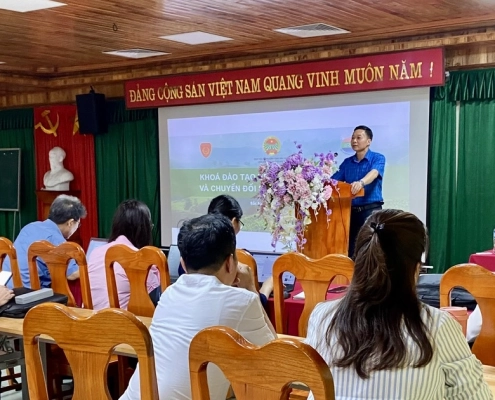
On April 6–7, 2026, in Bac Ninh Province, the Vietnam Institute for Research and Development of Rural Occupations (VIRI), in collaboration with the Bac Ninh Farmers’ Union Executive Committee – Farmers’ Support Fund Management Board; Vietnam Cleaner Production Centre Co., Ltd. (VNCPC), together with its partners, the Institute of International Economics and Law (IIEL) and the Institute for Research and Application of Technology (IRAT), organized a training workshop to strengthen the capacity of enterprises, cooperatives, and representatives of the Farmers’ Union in Bac Ninh Province on ESG, emission reduction, and digital transformation in agriculture.

The workshop was organized within the framework of the project “Eco-Fair Women-led Businesses in Green and Circular Agriculture in Vietnam” (Eco-Fair WBs), funded by the European Union. This activity is particularly relevant in the context of the agricultural sector facing an urgent need to transition toward greener, more sustainable development and adapt to the digital transformation trend.

Mr. La Van DoanVice Chairman of the Bac Ninh Farmers’ Union, delivering the opening remarks

The workshop aimed to support agricultural production entities in accessing modern development trends while enhancing their management capacity and market competitiveness. The program focused on promoting digital transformation in management and production, as well as disseminating sustainability standards that are increasingly becoming a “passport” for agricultural products to integrate more deeply into domestic and international value chains.

Dr. Le Hai Hung – Director of IRAT, providing guidance on greenhouse gas inventory development

Through a series of thematic sessions, participants were guided on applying green management practices to reduce emissions and use resources more efficiently, contributing to the achievement of Net Zero goals. They were also introduced to cleaner production solutions focusing on energy, water, and material savings in production processes, while receiving updates on Environmental, Social, and Governance (ESG) standards in the context of circular agriculture development.

Dr. Nguyen Thi Thu Hien – President of IIEL, presenting an overview of ESG and Net Zero

Ms. Do Thi Diu, M.Sc. – VNCPC Expert, presenting on resource efficiency and cleaner production

In addition, the workshop emphasized the role of digital technology as a key tool for improving management efficiency and enhancing value chain transparency, particularly in product traceability, an aspect increasingly valued by both markets and consumers. The application of technology not only helps enterprises and cooperatives optimize their operations but also contributes to increasing product value and expanding market access opportunities.

Dr. Nguyen Xuan Khoat – VIRI Expert, sharing insights on sustainability criteria in circular agriculture

Beyond knowledge sharing, the event also created opportunities for participating organizations to access free consultancy and technical support activities under the Eco-Fair WBs project, enabling them to gradually improve their production models toward greater efficiency and sustainability.

Participants receiving certificates upon completion of the training course

With its comprehensive approach combining awareness raising, capacity building, and technical support, the workshop is expected to contribute to accelerating the transition toward green and circular agriculture models at the local level, while strengthening collaboration among stakeholders within the agricultural ecosystem. This is considered an important step toward realizing the sustainable development goals of Vietnam’s agricultural sector in the new era.

VNCPC

VNCPC Surveys Agricultural By-Product Value Chains in Three Key Regions

Within the framework of the contract “Consultancy to conduct research on agricultural by-product value chains for transforming agricultural by-products into eco-products in the Northwest, Central Highlands and Mekong Delta regions”, Vietnam Cleaner Production Centre Co., Ltd. (VNCPC) carried out field survey activities in three key regions of Vietnam.

The survey activities were conducted to collect practical information on the current status of generation, collection, preliminary processing, use and commercialization of agricultural by-products such as rice straw, rice husk, cassava by-products, coffee husks and grounds, coconut fiber and many other biomass sources. This is an important basis for assessing the potential to develop value chains that transform agricultural by-products into eco-products in a circular, low-emission and environmentally friendly manner.

During the survey process, VNCPC’s team of experts worked directly with enterprises engaged in utilizing agricultural by-products to create value-added products. The survey focused on raw material procurement and supply capacity, operating scale, processing and preliminary processing technologies, storage conditions, the ability to meet raw material quality requirements, as well as investment needs and challenges related to markets, finance, certification and scaling up production.

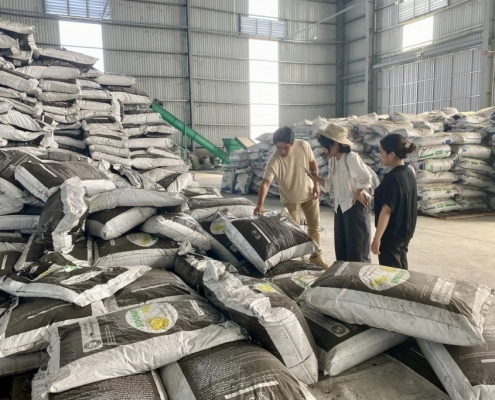
VNCPC worked directly with enterprises engaged in utilizing agricultural by-products to create value-added products.

Initial survey results show that Vietnam has great potential to develop agricultural by-product value chains into eco-products and circular materials. Many enterprises have begun applying technologies and innovative production models to effectively utilize agricultural by-product sources, contributing to waste reduction and the creation of new economic value.

Vietnam has great potential to develop agricultural by-product value chains into eco-products and circular materials.

However, effectively harnessing this potential still requires close coordination among raw material suppliers, manufacturing enterprises, innovation entities and stakeholders across the value chain. Some key challenges identified include the seasonal nature of raw material sources, fragmented supply chains, limited market linkages and difficulties in accessing financial resources for investment in production expansion.

Some key challenges identified include the seasonal nature of raw material sources, fragmented supply chains and difficulties in accessing financial resources for investment in production expansion

Through the field survey activities, VNCPC will continue to synthesize and analyze data to develop an overview of agricultural by-product supply sources, actors in the value chain, capacity gaps and the support needs of enterprises. The research results will serve as a basis for finalizing the project design, identifying appropriate objectives and proposing solutions to promote the development of eco-product value chains from agricultural by-products in Vietnam.

Eco-products made from agricultural by-products are highly diverse and abundant.

This activity also contributes to promoting circular economy models in agriculture, reducing greenhouse gas emissions, limiting environmental pollution from agricultural by-products and creating additional livelihood opportunities, while enhancing economic value for enterprises, cooperatives and local communities.

VNCPC