Carbon footprint: Why should businesses care about It in the Green transition?
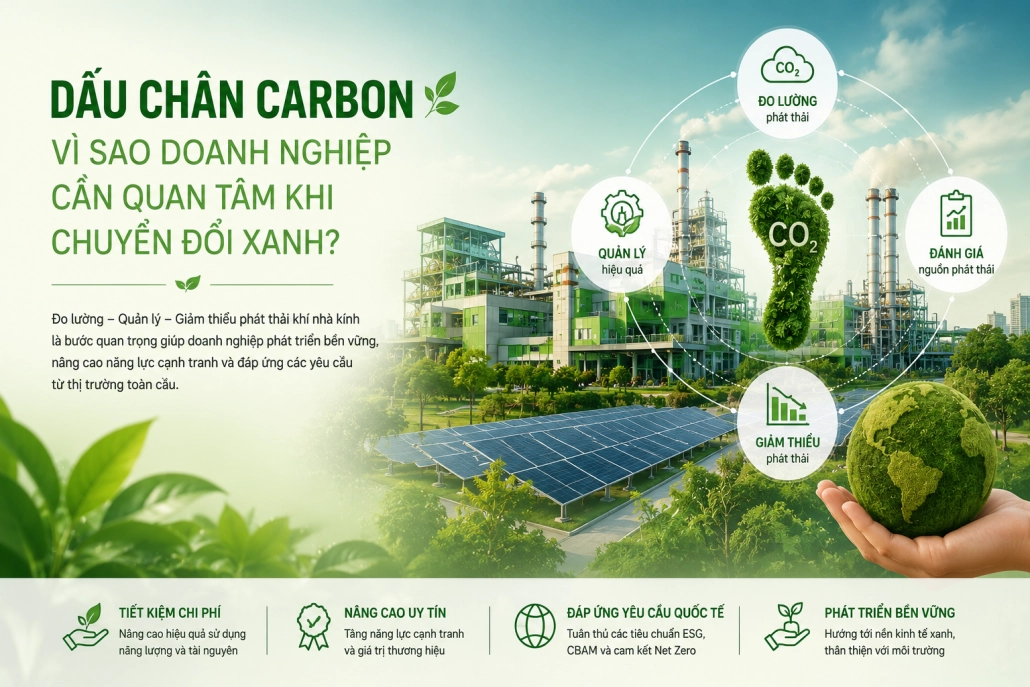
As climate change increasingly affects global production and trade activities, the “carbon footprint” has become one of the key indicators used to assess the level of greenhouse gas emissions associated with a business, product or service. It is not only an environmental concept, but also a factor that directly influences competitiveness and the ability to participate in international supply chains.
What is a carbon footprint?
A carbon footprint is the total amount of greenhouse gases generated directly and indirectly from the activities of an individual, organization, product or service throughout its life cycle. These gases are converted into carbon dioxide equivalent (CO₂e) for easier measurement and comparison.
For businesses, carbon footprints may arise from various sources, such as:
- Electricity consumption in production;
- Fuel use for boilers, generators and vehicles;
- Greenhouse gas emissions generated from production processes;
- Consumption of raw materials and chemicals;
- Logistics, transportation and supply chain activities.
Fully identifying emission sources is the first step in developing an effective emission reduction strategy.
Why do businesses need to measure their carbon footprint?
In the past, emission reduction was mainly voluntary. However, along with the trend toward sustainable development and global Net Zero commitments, emissions management is becoming an increasingly common requirement from governments, customers, investors and multinational corporations.
Measuring carbon footprints helps businesses:
- Understand emission sources across their production and business activities;
- Identify opportunities to save energy, water and raw materials;
- Develop emission reduction roadmaps suitable for their production conditions;
- Meet requirements related to ESG, CBAM, greenhouse gas inventory and international supply chain standards;
- Enhance brand reputation and access to export markets.
How is a carbon footprint calculated?
Carbon footprint calculation usually includes three basic steps:
Identifying emission sources
Businesses need to inventory all activities that generate greenhouse gas emissions, such as electricity use, fuel consumption, raw materials, transportation and waste treatment.
Collecting activity data
This includes electricity consumption, fuel use, raw material quantities, production output, transportation distance and other relevant data.
Applying emission factors
Activity data are multiplied by corresponding emission factors to convert them into CO₂e emissions, thereby determining the total carbon footprint of the business or product.
How can businesses reduce their carbon footprint?
After identifying their emissions, businesses can implement various solutions to reduce their carbon footprint while improving production efficiency.
Common solutions include:
- Conducting energy audits to identify opportunities for electricity and fuel savings;
- Applying Resource Efficient and Cleaner Production (RECP) to reduce the consumption of raw materials, water and energy;
- Investing in high-efficiency technologies and equipment;
- Increasing the share of renewable energy use;
- Optimizing logistics and supply chains;
- Conducting periodic greenhouse gas inventories and developing emission reduction plans.
In many cases, emission reduction solutions also help businesses significantly reduce operating costs and improve resource efficiency.
Opportunities from the green transition
Carbon footprint management not only helps businesses meet legal requirements, but also creates long-term competitive advantages.
As carbon markets and emission pricing mechanisms continue to develop, businesses that proactively reduce emissions will have more opportunities to access green finance, participate in sustainable supply chains and enhance their brand image in international markets.
Partnering with businesses
With nearly 30 years of experience in resource efficiency and sustainable development, VNCPC supports businesses in:
- Greenhouse gas inventory;
- Assessment of carbon footprints for businesses and products;
- Resource Efficient and Cleaner Production (RECP) consulting;
- Energy and water audits;
- Development of emission reduction and Net Zero roadmaps;
- Consulting on the development of ESG reports and sustainable development.
Measuring carbon footprints is not only a requirement of the present, but also a foundation for businesses to enhance competitiveness, meet international standards and pursue sustainable development in the future.
VNCPC